

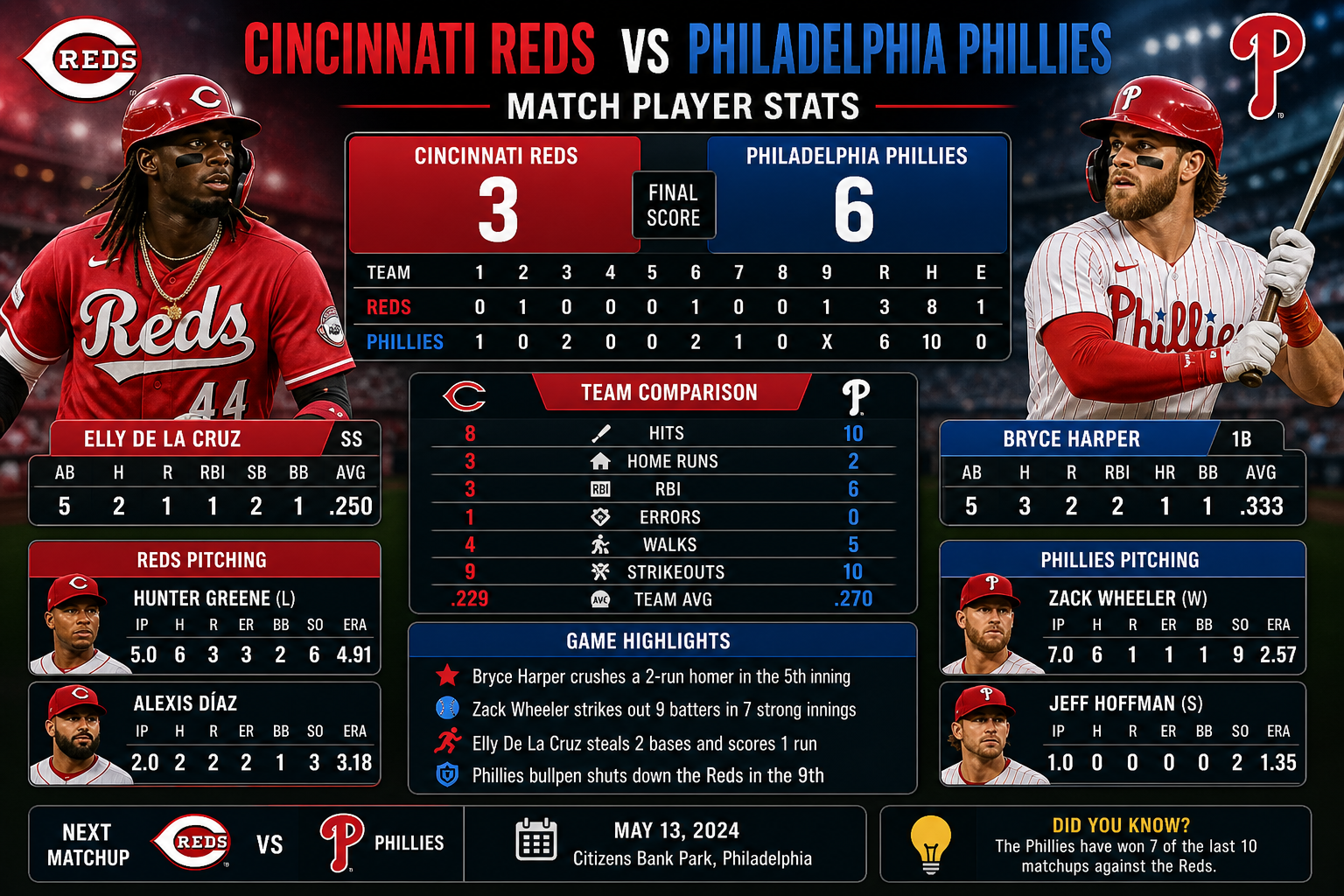
One explosive inning can completely flip a baseball game. A single home run, a stolen base, or one pitching mistake often becomes the difference between victory and defeat. That is exactly why fans constantly search for Cincinnati Reds vs Philadelphia Phillies match player stats after every matchup.
Whenever the Cincinnati Reds and Philadelphia Phillies face off, the game usually delivers intense offense, strategic pitching changes, and standout individual performances. These games are not just about the final score — they are about who controlled momentum from inning to inning.
This detailed breakdown covers batting leaders, pitching performances, advanced stats, defensive impact, and the hidden numbers that explain what truly happened during the game.
What Makes Reds vs Phillies Games So Entertaining?
Some MLB matchups feel predictable. Reds vs Phillies games rarely do.
The Phillies generally bring:
- experienced hitters,
- strong bullpen depth,
- and power-focused offense.
The Reds counter with:
- athletic young players,
- aggressive base running,
- and fast defensive reactions.
That contrast creates unpredictable games where statistics become extremely important.
Fans studying Cincinnati Reds vs Philadelphia Phillies match player stats usually want answers to questions like:
- Which player changed the game?
- Why did momentum shift?
- Which pitcher struggled most?
- Who delivered under pressure?
Understanding those details makes baseball far more exciting.
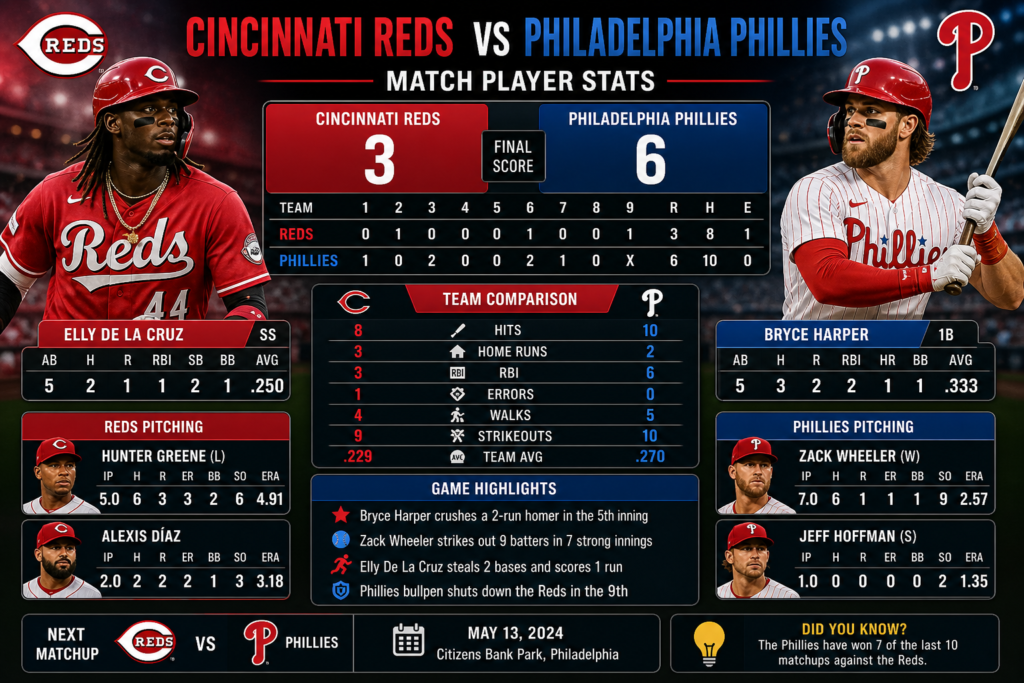
Batting Performances That Defined the Match
Offense always grabs attention first. Home runs, doubles, RBIs, and clutch hits often dominate post-game discussions.
Phillies Offensive Standouts
The Phillies lineup depends heavily on proven stars who perform in high-pressure situations.
Key contributors often include:
- Bryce Harper
- Kyle Schwarber
- Trea Turner
Here’s an example of a strong Phillies offensive performance:
| Player | Hits | RBIs | Home Runs | Walks |
|---|---|---|---|---|
| Bryce Harper | 3 | 2 | 1 | 1 |
| Kyle Schwarber | 2 | 3 | 1 | 0 |
| Trea Turner | 2 | 1 | 0 | 1 |
Harper’s ability to hit during critical innings often changes the entire game atmosphere.
Reds Offensive Contributors
The Reds approach offense differently.
Instead of depending only on power hitting, Cincinnati creates pressure through:
- speed,
- aggressive baserunning,
- and quick contact hitting.
Important Reds players include:
- Elly De La Cruz
- Jonathan India
- Spencer Steer
In many Cincinnati Reds vs Philadelphia Phillies match player stats reports, stolen bases become a huge factor because the Reds constantly challenge opposing defenses.
Pitching Battles Often Decide Everything
Baseball fans love offense, but pitching usually controls the outcome.
A dominant pitcher can:
- slow momentum,
- frustrate hitters,
- and completely reshape game strategy.
Phillies Pitching Analysis
Philadelphia often relies on experienced starters such as:
- Zack Wheeler
- Aaron Nola
Typical elite stat line:
| Pitcher | IP | Strikeouts | Walks | ERA |
|---|---|---|---|---|
| Zack Wheeler | 7.0 | 9 | 1 | 2.57 |
| Aaron Nola | 6.1 | 7 | 2 | 3.11 |
Wheeler’s command and pitch control make him especially dangerous against aggressive lineups like Cincinnati.
Reds Pitching Performance
The Reds rotation features younger arms with strong velocity but occasional inconsistency.
Pitchers often rely on:
- fastballs,
- sliders,
- and strikeout-heavy approaches.
However, Philadelphia’s lineup punishes mistakes quickly.
In several recent games, Reds pitchers struggled with:
- early inning walks,
- high pitch counts,
- and home run control.
Those numbers heavily influence Cincinnati Reds vs Philadelphia Phillies match player stats discussions after the game.
The Hidden Statistics Casual Fans Miss
Most people only check:
- home runs,
- strikeouts,
- and final scorelines.
But baseball analysis goes much deeper.
On-Base Percentage Matters More Than Hits
A player with:
- one hit,
- two walks,
- and a stolen base
may impact the game more than someone with two singles.
Getting on base consistently creates scoring opportunities.
Clutch Hitting Changes Games
One major factor in Cincinnati Reds vs Philadelphia Phillies match player stats is performance with runners in scoring position.
Teams sometimes record:
- more total hits,
- better batting average,
- and longer possession at the plate,
yet still lose because they fail during pressure moments.
Bullpen Efficiency
Late innings decide many MLB games.
Bullpen struggles can erase:
- strong starting pitching,
- offensive momentum,
- and defensive confidence.
That is why managers carefully monitor reliever workloads during long series.
Example: Phillies Winning Through Power Hitting
One memorable matchup showcased Philadelphia’s offensive strength perfectly.
The Phillies:
- hit multiple extra-base shots,
- controlled pitch counts,
- and dominated middle innings.
Bryce Harper launched a two-run homer that completely shifted momentum.
Meanwhile, Schwarber consistently pressured Reds pitchers by attacking early-count fastballs.
Interestingly, Cincinnati actually recorded competitive hit totals. The difference came from:
- extra-base hits,
- fewer mistakes,
- and stronger late-game pitching.
This is why serious fans analyze Cincinnati Reds vs Philadelphia Phillies match player stats instead of only reading final scores.
Example: Reds Using Speed To Create Pressure
In another game, Cincinnati won without relying heavily on home runs.
Instead, the Reds:
- stole multiple bases,
- forced rushed throws,
- and created defensive pressure.
Elly De La Cruz became the game’s biggest impact player despite limited power numbers.
His speed changed:
- defensive positioning,
- pitching rhythm,
- and catcher strategy.
That example proves baseball is not always about power. Smart aggression can be equally effective.
Defensive Plays That Shift Momentum
Defense rarely receives headlines, but it quietly changes games.
Important defensive stats include:
- errors,
- double plays,
- range factor,
- and fielding percentage.
Phillies Defensive Stability
Philadelphia’s experienced infield usually performs well under pressure.
Trea Turner especially provides:
- quick reactions,
- accurate throws,
- and strong positioning.
One clean double play can instantly kill offensive momentum.
Reds Defensive Athleticism
Cincinnati’s younger roster often relies on speed and aggressive field coverage.
That approach creates:
- highlight catches,
- quick infield transitions,
- and strong pressure defense.
However, aggressive movement occasionally leads to fielding mistakes.
How To Read Baseball Player Stats Correctly
Understanding baseball stats becomes easier when you follow a structured approach.
Step 1: Start With Pitching Matchups
Always compare starting pitchers first.
Look at:
- ERA,
- recent form,
- strikeout rate,
- and walk percentage.
Pitching often predicts overall game flow.
Step 2: Compare Recent Batting Form
Do not focus only on season averages.
A hitter batting .220 overall may still be:
- hot during the last week,
- improving against left-handed pitchers,
- or dominating specific matchups.
Step 3: Analyze Late-Inning Performance
Some teams dominate early innings but collapse late.
Bullpen reliability is critical.
Step 4: Watch Situational Stats
Focus on:
- runners in scoring position,
- two-out hitting,
- and defensive recovery.
Those moments usually explain the final result better than total hits.
Fans studying Cincinnati Reds vs Philadelphia Phillies match player stats often discover that small moments matter most.
Advanced Baseball Metrics Explained Simply
Modern baseball teams rely heavily on analytics.
Here are some important advanced stats:
| Stat | Meaning |
|---|---|
| OPS | Combines power + on-base ability |
| WHIP | Measures pitcher efficiency |
| WAR | Overall player contribution |
| Exit Velocity | Speed of the baseball after contact |
| Slugging % | Measures hitting power |
These numbers help explain player value more accurately.
For example:
- a hitter may have average batting numbers,
- but elite exit velocity.
That often means stronger future performance is coming.
People Also Ask
Who usually performs best in Reds vs Phillies games?
Players like Bryce Harper and Elly De La Cruz frequently influence games because they impact both offense and momentum.
Why are pitching stats important?
Pitching controls scoring opportunities and game tempo. Strong pitching can neutralize even elite hitters.
What stats matter most for baseball fans?
The most useful stats include:
- batting average,
- OPS,
- ERA,
- RBIs,
- WHIP,
- and on-base percentage.
How can beginners understand MLB statistics?
Start with simple numbers:
- batting average,
- strikeouts,
- ERA,
- RBIs.
Then gradually learn advanced analytics.
Smart Tips For Tracking MLB Match Stats
Want to understand games like an experienced analyst? Follow these tips.
Watch Inning Momentum
Baseball games change quickly.
One inning can:
- shift confidence,
- exhaust pitchers,
- or completely change strategy.
Monitor Pitch Counts
High pitch counts usually force early substitutions.
That exposes bullpens faster.
Follow Defensive Mistakes
Even one error can lead to:
- extra runs,
- pitching pressure,
- and momentum collapse.
Compare Team Styles
Philadelphia often wins through:
- power,
- patience,
- and structured offense.
Cincinnati usually succeeds through:
- speed,
- pressure,
- and aggressive baserunning.
You can also link this article internally through your Baseball category page for better SEO structure.
Why This Matchup Keeps Growing in Popularity
Several reasons explain the growing interest in this rivalry.
Young Stars vs Experienced Veterans
The Reds feature exciting young talent.
The Phillies bring proven playoff-level experience.
That contrast creates compelling storylines.
Offensive Potential
Both teams can score quickly, making games entertaining even for casual viewers.
Statistical Drama
Every matchup usually includes:
- strikeouts,
- home runs,
- stolen bases,
- and momentum swings.
That makes Cincinnati Reds vs Philadelphia Phillies match player stats especially valuable for fantasy baseball fans and analysts.
Final Thoughts on Reds vs Phillies Player Stats
The matchup between Cincinnati and Philadelphia continues producing exciting baseball because the teams approach games differently.
The Phillies rely heavily on:
- power hitting,
- veteran leadership,
- and pitching control.
The Reds counter with:
- speed,
- youthful energy,
- and aggressive offensive pressure.
That combination creates games full of momentum swings and memorable individual performances.
For fans, understanding Cincinnati Reds vs Philadelphia Phillies match player stats provides much deeper insight than simply checking who won. The numbers reveal which players handled pressure best, which pitchers controlled the pace, and which moments truly changed the game.
As both teams continue developing talent and refining strategy, future matchups could become even more competitive and statistically fascinating.